Story
Archives: The Engine of the Hospital
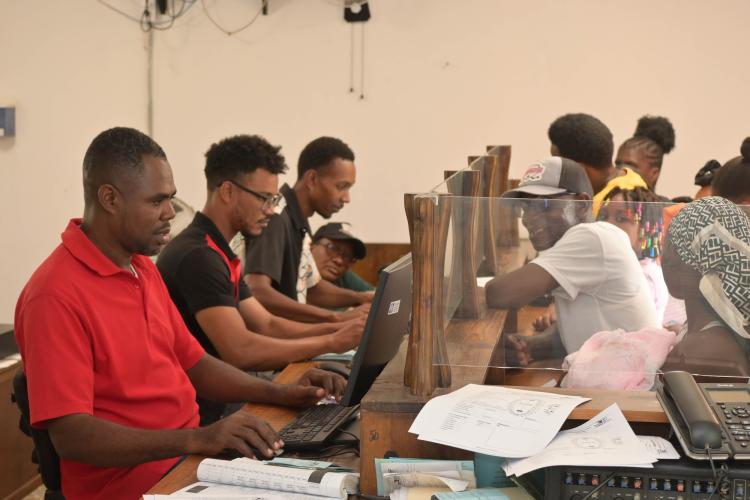
When patients arrive at St. Boniface Hospital, they first see the archives team. Tucked away in an office near our outpatient clinic, archives is a vitally important but often-unsung team not just at our hospital, but at any hospital. So, what does our archives team do?
For St. Boniface Hospital, archives checks in patients, coordinates patient care between departments, and stores, organizes, and disseminates data.
If it seems like this is a lot of different jobs for one department, you’re right. In some large international hospitals, these jobs are often split into entirely separate teams with dozens of employees. Although we’re one of the largest hospitals in Haiti, we’re quite small compared to major international hospitals! Our archives team—like many of our teams—must therefore wear several hats.
“Our role is to receive patients and prepare their files so they can see a doctor,” says archives team member Jean-Tony Celange. “We also organize and file records, ensuring that if a patient needs to move elsewhere within the hospital, we can retrieve their file to facilitate their continued care. Furthermore, we schedule appointments for surgeons.”
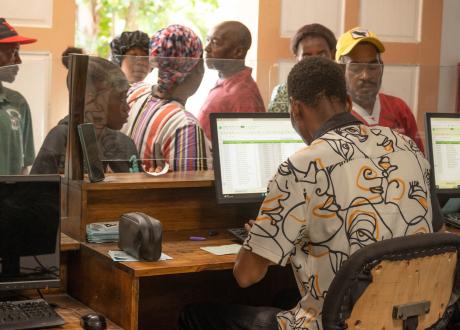
The archives team works with hundreds of patients per day.
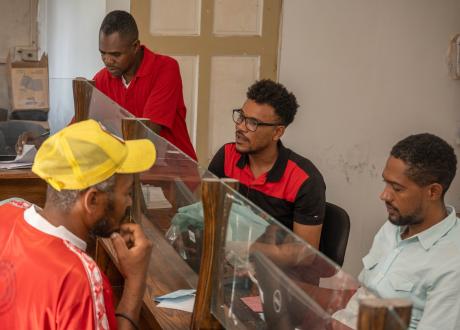
People in this public-facing role must be courteous, kind, and have incredible attention to detail.
Our work in the archives is vital; I would describe it as the engine of the hospital, as a hospital cannot function without data.
Jean-Tony Celange
Care coordination is a complex and intense part of the job, involving many moving parts. And while we have digitized many aspects of our recordkeeping over the years, hospitals like ours are still heavily reliant on paper documentation. The archives team must be extremely organized at all times to make sure patients have seamless continuity of care and ensure departments remain on top of where patients are going across the hospital.
As if that wasn’t enough, Jean-Tony says that his team manages data from across hospital departments. “Whenever the hospital engages in planning, they consult the archives to obtain data—such as the number of births, the total number of patients visiting the facility, and even the number of deaths.” Each department generates a lot of data. For example, our maternity department alone records dozens of data points for both mother and baby. Multiply that by nearly a dozen other clinical departments—that’s a lot of numbers to keep track of!
Like many staff at St. Boniface Hospital, Jean-Tony has worked here for a long time. Although he has had other roles, he’s particularly proud of what he does on the archives team. “The hospital is significant to the community—and, I would argue, to the world at large—as I, in my capacity as an archivist, encounter people from all over who come here to receive care. For us in the Fond-des-Blancs community, the hospital is a cherished asset, and as a young person, I take great pride in working here.”